
Students Unite!
The high school student protests aren't getting enough attention

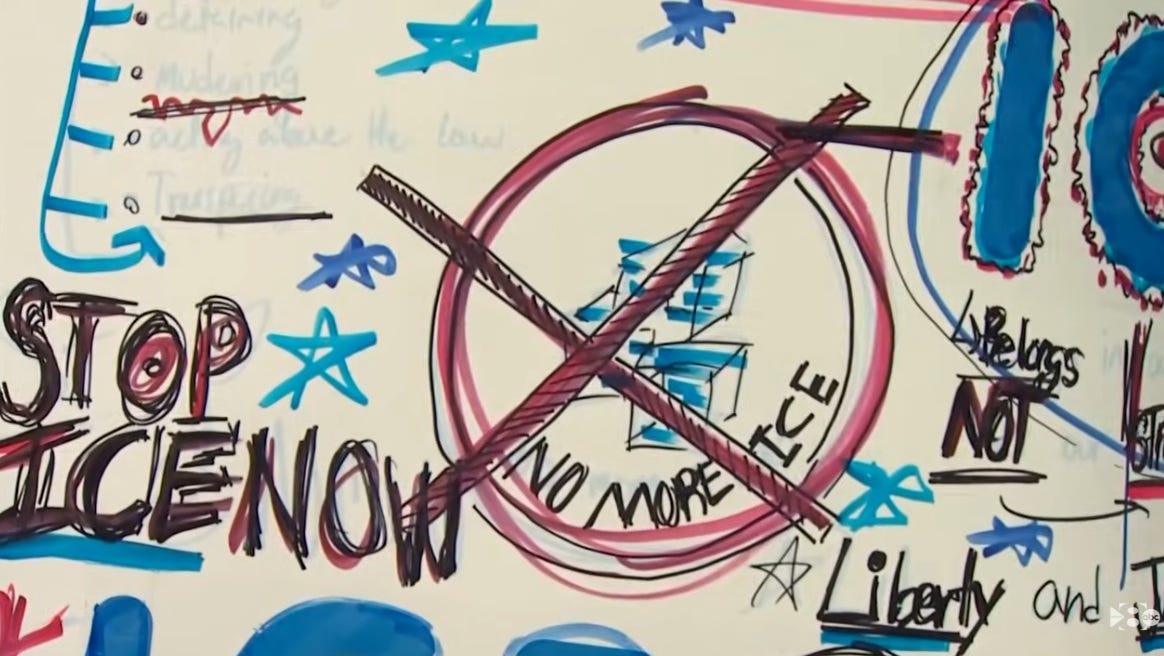
If you need a bit of inspiration, might I suggest that you spend some time perusing a few stories about the walkouts by middle and high school students that are sweeping the land. Among the most under-covered developments right now, these grassroots protests are bubbling up, well, everywhere. Here’s Nebraska, here’s south Florida, here’s Oklahoma, here’s Baltimore, here’s Utah, here’s Kentuckiana, which, admit it reader, you did not know was really a place. While some of these events have been part of coordinated national protests, most appear to reflect what activists referred to, back in the day, as a ‘prairie fire,’ moving swiftly from school to school.
As for why these students are protesting, I’ll let them explain it. Here’s El Paso, TX junior Sophia Gutierrez, on why she organized one of the walkouts:
It’s heartbreaking to see what ICE agents are doing to students, to kids, to mothers, to fathers across the country. And I’m just so disappointed in the country. Seeing how our democracy is under attack is making me feel hopeless. But these protests have reignited something in me and my peers.
In other words, these students feel exactly the way that so many of us do, and they’re determined to do something about it. There’s also a strong sense that students have to take action because adults are failing to meet the moment. “If an older generation cannot recognize those truths, then let it be the younger generation that takes a stand, makes the right decisions and shows them,” explains Jack McNally, one of hundreds of students in Carmel, Indiana—that would be two hours-ish north of Kentuckiana—who walked from their high school to city hall to protest ICE.
The kids are all right
I’ve been thinking a lot about student protests of late, thanks to an amazing new history of teen activism. The work of scholar Aaron G. Fountain Jr., High School Students Unite! Teen Activism, Education Reform, and FBI Surveillance in Postwar America is a first-of-its kind exploration of the teen-led high school movement that swept the country during the 60’s and 70’s. You can hear my interview with Fountain in the latest episode of my podcast, Have You Heard. As Fountain observed recently:
High school students are organizing politically in ways reminiscent of their counterparts more than 50 years ago. When people think of student activism, they typically picture college campuses. Yet, during the 1960s and 1970s, teenagers built social movements that intersected with broader grassroots struggles and responded to both local and national issues.
Another key overlap between today’s student walkouts and the protests of yore? The freakout by adults, who insist that students are being manipulated by other adults, aka ‘outside agitators.’ As Fountain uncovered by submitting more than 1,000 information requests, student activists back in the day were routinely surveilled by the FBI, local police departments, and military intelligence units. The spying often commenced at the request of the activists’ own parents, like the North Carolina mother who penned a missive to J. Edgar Hoover, warning that the student group her 17-year-old was involved in was likely a Communist front. (Hoover, by the way, got right on it.)
Fast forward to the present and the accusations that student protestors are under the influence of some indoctrinating force are a staple of the right-wing outrage machine. Texas Governor Greg Abbott was quick to lay blame, first at the feet of the state’s teachers, threatening teachers who “facilitate walkouts” with investigations and even the loss of their teaching licenses, then on entire school districts, which now face a loss of funding if the walkouts continue. The deep-pocketed conservative advocacy group, Defending Education, has even identified the devious entity that is secretly pulling the student activists’ strings: the climate change org known as the Sunrise Movement. Spoiler: the group’s ‘real’ agenda is every bit as nefarious as the one that J. Edgar Hoover was out to unmask sixty years ago:
Activists say they’re “fighting fascism,” but their aim is something else entirely: dismantling Western cultural norms and eroding the institutions that hold society together — like orderly conduct and meritocratic standards. The leftist playbook is clear, cold and alarmingly effective.
Not just ICE
One of Fountain’s most insightful observations is that the surge of high school activism in the 60’s and 70’s was never just about the issues themselves: civil rights, racial segregation, and opposition to the Vietnam War. Students were also pushing back against what they saw as the oppressive nature of schooling in America. And the harder adults sought to restrict the students’ political activities, the more the activists questioned whether the Constitution and democracy applied to them. Fountain’s book is filled with vivid examples of students in unlikely places pushing for more freedom within their schools, but I’m going to cite a more recent case. Here’s 17-year-old Angel Chavez questioning Governor Abbott’s efforts to keep Texas students like him from protesting:
It’s really just disheartening to see everything that’s happening and see that just because we’re a minority, they think they could shut our voices down. Just because we go to public school, they think that there’s a new way that they can stop us from speaking out. I’m not a political science major, but this feels unconstitutional.
Students today have reasons-a-plenty to protest. They’re on the receiving end of book bans, limits on what they and their teachers can discuss in school, and restrictions on what kinds of organizations they can join. As Jack Schneider and I document in our book, The Education Wars, Gen Alpha is also the first generation to experience a roll back of their civil rights. Then there is the ‘discourse,’ which has taken a sharply anti-student turn. To quote my recent post: “The kids are dumb and getting dumber. They can’t add or read the books they are no longer assigned, rousing themselves from their stupid stupors only to demand extra time on tests or another (now meaningless) A.” And don’t forget students’ refusal to protest, something their elders were bemoaning just months ago.
Perhaps the most important lesson from High School Students Unite! is on the impact of student protests. As Fountain documents, teens helped turn public opinion against the Vietnam War and led a grassroots movement in support of desegregation. They transformed their own school districts and successfully pushed for expanded student rights. In the process, they learned that action and solidarity are contagious, and that the adults who try to shut them down or shut them up are fighting a losing battle.
The teens who are walking out of school right now are learning these same lessons. And unlike the Vietnam era, when the public was broadly hostile to student protestors, today’s activists start out with the public overwhelmingly on their side. According to a recent poll, 59% of Americans say that the protests against ICE are legitimate; among college graduates, that number rises to 73%. As one political analyst observed, this is the stuff of landslides.
When students in Dekalb County, Georgia planned a walkout last month, they expected 50-100 of their classmates to join in. Instead, 2000 students participated. Organizer Sinnit Siye said students were initially scared to protest, for fear of being targeted by ICE or other enforcement groups:
I saw my friends who were feeling afraid, who were just not feeling okay coming out here. They came out here. Nearly the entire school was here. People who said they were too scared to come, they came because of the numbers.
My students in Washington State walked out last week :)
So sick of people saying these kids just want to get out of school. I’m not saying this isn’t the motivation for some, but in my twenty-eight years of teaching, I taught so many kids who were thoughtful and put their energy behind causes like this.