

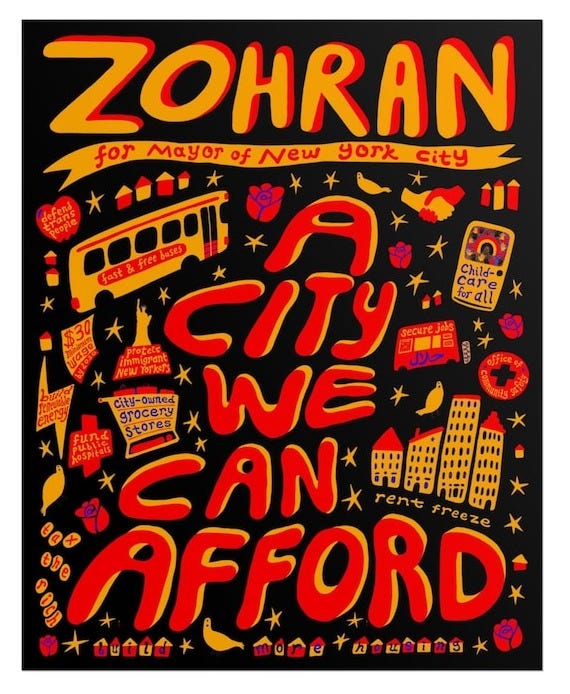
For months now I’ve been kicking around an essay that tries to explain why the ascendant left-wing of the Democratic party—those Democratic Socialist candidates who’ve been disrupting party primaries—is almost completely silent when it comes to the issue of public education. That question has taken on new urgency in light of the essay that officially broke the Internet, spawning a bazillion takes and forever rebranding the author as a monogram: NHJ. But the essay and its fallout have also spotlighted the fact that the NYC’s mayor, whose upset victory was powered by rage against inequality, has so little to say about the city’s unequal, segregated schools.
Full disclosure: I am a huge Zohran Mamdani fan. But I have been deeply frustrated by his administration’s lack of a vision for what is not only the nation’s largest school district, but the largest entity, by cost and headcount, under the mayor’s control. “What’s Mamdani’s agenda for K-12 education in NYC?” asked the education news site Chalkbeat recently, concluding that after six months, it was hard to say. Analyzing every press release released by the administration, Chalkbeat noted that just 11 had anything to do with the city’s schools. More recently, Mamdani announced a one-year ban on AI in elementary and middle schools in NYC—a smart move, given the parent-powered grassroots revolt against ed tech. But whereas we know the mayor’s views on, say, housing or worker power, his vision for public schools in the city remains largely mysterious.
The K-12 Hole
It’s not just Zo, as the New York Post likes to refer to him. The DSA platform barely touches on public education. The “thriving working class communities” the group envisions apparently don’t include schools. And with the exception of a handful of notables—Francesca Hong in Wisconsin, Angie Nixon in Florida and David Morales in Providence, RI to name a few—the candidates running under the DSA banner don’t mention K-12 education. Nithya Raman, the DSA candidate who will likely be the next mayor of Los Angeles, identifies 11 priority issues on her website. Animal welfare makes the cut, but LA’s schools, which educate more students than any district in the country save for NYC, do not. Then there’s Melat Kiros, who recently unseated a fifteen term incumbent in a district that makes up most of Denver. In an interview prior to her upset victory, she laid out this inspiring vision of the future:
I have a fundamental belief that our government is responsible for meeting our most basic needs, and in the same way that we have security and knowing that if our house is on fire, we can call the fire department, or if our home is burglarized, we can call the police, that if we are sick, we should be able to go to a doctor down the road and we should be able to go to that doctor on a yearly basis for primary care. We should be able to send our kids to the local public university tuition-free.
Notice anything missing? Lest you think that I’m unfairly picking on the DSA here, this lack of concern over what happens in the period between universal pre-K and free college is a broader problem on the left. The Working Families Party, for example, just rolled out its Guarantee, the product of a multi-year effort to come up with a proactive economic populist agenda that can bring the multiracial working class together. It doesn’t mention education at all.
Backlash
In recent months, I’ve reached out to all kinds of folks to ask about the absence of education from the left’s vision. I’ve talked to friends of mine who are active in left politics, activists I’ve encountered online, and even a few candidates. The explanation cited most frequently is a straightforward one: that the young activists who dominate the DSA don’t have children. Some version of realpolitik also tops the list. Left-wing mayors with bold, transformative visions cannot afford to alienate the powerful teachers unions, typically the largest organized force in the city. Witness, for example, the current stand off in NYC over a controversial plan to pay paraprofessionals, among the lowest paid employees in the schools, a one-time $10K bonus. After Mamdani flip-flopped on supporting the payments, the teachers union chief threatened an “all-out war” against him.
While both of these explanations are probably correct, I think that the composition of the electorate that has been increasingly drifting to the left may tell us more. Much has been made of the educational credentials of DSA voters, more than 80 percent of whom have college degrees, and over a third of whom have a master’s degree, a doctorate or some other professional degree. That these voters are also struggling financially has made them the target of endless mockery, for majoring in “Southeast Asian feminist literature” rather than a more lucrative STEM subject (Fox’s Jesse Watters) or secretly envying “more successful professionals,” like those who drill for oil and gas (Palantir’s Alex Karp.)
While voters who are “highly educated, downwardly mobile” may indeed be the DSA’s sweet spot, as Nate Silver calculated recently, we can also think of them as part of a (potentially) much broader coalition: those for whom education hasn’t paid off. As Noam Scheiber chronicled in his terrific recent book, Mutiny: The Rise and Revolt of the College Educated Working Class, young voters who can’t afford homes, or childcare, or life increasingly feel like they’ve been sold a bill of goods regarding the payoff of college. As the college wage advantage drops, the ranks of the restive precariate will only grow. Nor are these folks all clustered in NYC’s “Commie Corridor” or the equivalent in other blue states. Of the nearly 10 million Americans who are in default on their student loans, for example, the highest concentration is in the south.
According to the most recent polling, some four in ten Democrats now consider themselves as democratic socialists, while more than half of Ds hold positive views of socialism. In addition to polls showing rising support for economic solutions to economic problems, surveys also show that the left, especially the young left, cares less about K-12 education than older voters. But perhaps we’re looking at this the wrong way too and that the kids are simply telling us that they’ve lost faith in the mantra that education is an economic escalator.
Nearly a decade ago I wrote a piece that is still among my top faves, making the case that education reform had essentially ‘eaten’ the Democratic Party. The TLDR version is that in the quest for solutions to inequality that didn’t entail taxing the rich, the Democrats embraced charter schools and their billionaire backers, while making enemies of teachers and especially their unions. If bad teachers were the cause of generational poverty, as the “documentary” Waiting for Superman posited, then the billionaires who went to war against them were our new heroes. Forget that their other pet cause often seemed to be immiserating the parents of the would-be charter school students—this was a win/win.
I’d argue that despite the DSA’s relative silence on education issues, its rise is also a backlash to billionaire-driven school reform: the Bloombergs, the Broads, the Griffins, the Loebs. As one Mamdani campaign activist told me, “This is a movement that says we need redistribution. Nobody buys the idea that somehow charter schools are the answer to inequality. ”
It’s the structure, stupid
For the past five years I’ve been teaching a course called “The Politics of Public Education,” alternating between Yale and an actual jail—a medium security men’s prison in Massachusetts where I teach in the Boston College Prison Education Program. We start each semester talking about the myriad and conflicting purposes of education, and without fail, the favorite reading of both of these group’s is Jean Anyon’s nearly five-decades-old observational analysis of five different New Jersey elementary schools, each one preparing kids to occupy a specific rung on the social ladder. My Yale students mostly, but not exclusively, come from the classrooms that correspond to the ladder’s upper rungs: what Anyon calls “affluent professional” and “executive elite” schools. My incarcerated students, meanwhile, immediately recognize the schools Anyon designates as “working class”: chaotic, at times violent places, staffed by adults who were disinterested at best, uncaring at worst, with learning that rarely rose above rote.
In arguing that schools play an essential role in reproducing the unequal structure of economic relationships in which we work and live, Anyon offers up a class analysis that my students have rarely encountered before. What she doesn’t provide are any answers regarding whether doing school differently might disrupt this class hierarchy—an omission that plagues much education analysis on the left. Reflecting on their classic, Schooling in Capitalist America, twenty five years later, Samuel Bowles and Herbert Gintis lamented that they’d avoided the question of what schools should be, and what, if anything could be done to improve them.
The point of this digression is that this view of schools as, not just reflecting, but deepening the contradictions of economic life, as Bowles and Gintis would have it, continues to shape the way the left thinks about education. This is why Mamdani, for example, is blazing a bold path when it comes to empowering workers, but seems comparatively visionless about the city’s schools. In her recent appearance on Brian Lehrer’s show, Nikole Hannah-Jones challenged Mamdani about his lack of a plan to address the racial and economic isolation of students in schools like PS 307, she argued that “nothing can help the working class change its material condition more than actually having access to an equal and quality education.” But it is the collective loss of faith in this belief that has been propelling the ascent of the Democratic Party’s left wing.
Schools as socialism
Ironically, the left’s surge in places like NYC, Providence and Washington DC is at least partly fueled by the desire to reclaim public goods, post pandemic. “It is in cities that voters most routinely encounter, and thereby come to value, public goods,” wrote David Wallace-Wells this summer, describing what he argues could be the dawn of a new political era for American cities. In an interview with Wells, Nithya Raman, the DSA candidate running to run Los Angeles, made the case that cities are the natural proving ground for the left:
To me, a city feels like the most impactful place — where you can make the case for progressive politics, where you can make the case for government working well because the impacts of functional government are so immediate and so real.
Which makes it all the stranger that public schools are somehow missing from the list of public goods that these voters value. After all, the right’s decades-long, and increasingly successful, crusade to dismantle public education is first and foremost about schools’ public-ness. Providing every American kid, papers or not, with a K-12 education that we collectively pay for is just about the most socialist thing we do in this country.
Speak up
As left-wing pols stay silent on the topic of the nation’s schools, there are plenty of other folks who have a great deal to say. The response to NHJ’s essay and its aftermath among education reformers, who’ve been wandering in the wilderness through the Trump years, has been euphoric. Mamdani et al may want to focus on material conditions and doing battle with billionaires, but here, at last, is an opportunity to shift the conversation back to schools. As one such billionaire implored, “We can’t wait to solve all societal issues before demanding higher performing schools.”
And yet any opportunity for the education reform movement brings its own dangers. The coalition that powered the cause last time around, the unlikely assemblage of billionaire philanthropists, charter school proporents, big city mayors, and civil rights groups, is mostly dead. Instead, self-styled school fixers are far more likely to find allies on the right these days, where talk of “standards,” “excellence,” and “back to basics” overlaps with race science and xenophobia.
There is also the future of the Democratic Party to consider. The upsurge in support for the left is a backlash against the party’s establishment—against the gerontocracy, against support for Israel. But education is another key fault line. For decades, Democrats have been telling us that “what you earn is what you learn,” as Bill Clinton liked to say (and Rahm Emanuel is still saying). This insistence that every economic problem is really an education problem, as writer Tom Frank so aptly put it, is an underappreciated source of the Democrats’ woes, alienating workers without college degrees, and increasingly, even those who did follow the party’s prescription for success.
As centrists seek to tamp down the party’s left wing, they’ll be trying to head off demands for a progressive policy agenda by once again blaming our economic woes on the schools. Ironically, the best way to put this tired argument to rest may be for the left to finally start talking about education.
Very interesting post. I'd go a bit further and say that a big part of the reason you don't see many ideas for education coming from the left is that a lot of the ideas associated with the left (I will die on the hill that these are NOT actually left-wing ideas) have been horrible failures. Especially since COVID, a lot of the ideas pushed by left-leaning ed professors and activists have resulted in lower standards and more chaotic schools.
Whenever I mention this to education activists-- with whom I agree on broader issues of funding, working conditions, and school privatization-- they either deny the fact that ideas like restorative justice, no-fail policies, and "accommodations for all" have actually been adopted widely (wrong), or insist that those policies are good but have been poorly implemented. Meanwhile, among most actual teachers, there is broad agreement that these have been disasters.
It's this disconnect between your average teacher (or parent, if they actually know what's happening in their local school) and the layer of education activists that will bedevil left wing politicians. Honestly, I breathed a massive sign of relief when it became clear that Zohran wasn't really going to touch educational issues because I assumed whatever he proposed would be shaped by some of the worst actors in the education world.
Finally, I'd say that if we want a path forward, we really do need to reclaim terms like "excellence" from the right. It's depressing to see that it's the school privitization crowd that is taking the lead in pushing the return of whole books and instructional practices that are based in science rather than magic.
Once again, I agree. I would argue that the left is missing a vision for education more broadly -- not simply k-12. "Fully funded" is about the extent of any progressive vision for public education that I can find, which isn't much of a vision at all.
The left has internalized the corporate-created vision for all education that has dominated our political system since Reagan: Education is about job training, economic stability/advancement, etc. This is the triumph of human capital theory, the single most destructive thing to ever happen to education in the U.S.
But the education system cannot change the labor market, period, end of story. The jobs are the jobs. And most of them are low paying and low skilled, regardless of what the entire universe tells us.
If the left doesn't see that its entire conceptualization of the purpose of education is one fully created by corporate America with the help of mainstream Economists, then it can never have its own vision for education.