

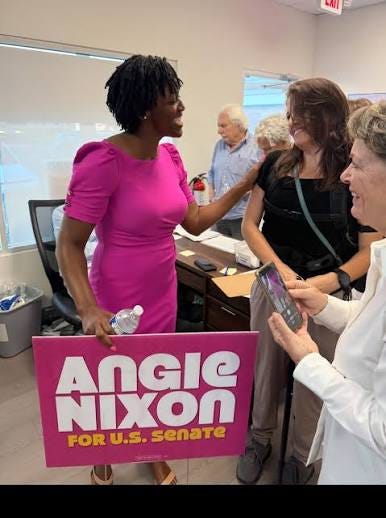
First, a confession. Since Florida’s Angie Nixon shocked her state, and the world, with her upset primary win, I’ve come down with a fierce case of Angie-mania. While deadlines languish, I’ve been watching her in action in clips like this, this, and especially this. But here’s something that you may not know about Nixon. As a state rep, she’s been a vocal opponent of unregulated school vouchers in Florida, a position that helped power her unlikely primary victory. Go back a few years to when the Florida GOP was making vouchers available to even the wealthiest Floridians and there was Nixon predicting exactly what would happen:
Our local public schools are an investment we all make to create a brighter future for students and our communities as a whole,” Nixon said. “But Florida’s GOP leadership is legislating publicly funded discrimination in education, leading to a new era of segregation. This bill will give handouts to wealthy families by redirecting public tax dollars to institutions with zero oversight and accountability while defunding public schools that serve over 90% of our students.
Nixon, by the way, offered several amendments to that universal voucher bill, including one that would prevent Floridians earning more than $1 million per year from qualifying for a voucher and another that would keep participating schools from discriminating against students. Big surprise - her amendments were rejected. But Nixon, who has shown a real knack for understanding the concerns of her constituents, was on to something. It turns out that even voters who like the idea of school choice think that it makes sense to rein in the sorts of vouchers-gone-wild programs that are now the rule in Florida and beyond.
Mom Populism
Nixon isn’t the only Democrat who has figured this out. This summer I embarked on an ambitious reporting project as part of a story I wrote for The New Republic. I set out to interview as many Democrats who’d flipped state legislative seats as I could. (Since Trump returned to office, there’ve been 30 such flips—31 as of last week.) I kept noticing that education seemed to figure prominently in these campaigns, yet often went unnoticed in media reporting. Vouchers, specifically opposition to unregulated voucher programs, turn out to be major theme. Show me a candidate who flipped a formerly GOP seat, or is running competitively in a red state, and I’ll show you a critic of vouchers.
Texas isn’t the only state where education has emerged as a potent issue for Democrats. As of March 2026, in the 30 state legislative races where Democrats have flipped seats since Trump returned to office, public education was often a central issue. It’s not hard to see why. As the GOP has shifted sharply in favor of private school vouchers, Democrats are increasingly running against candidates who no longer believe in public education at all, even as constituents in both parties still have kids in the local schools. Ascendant populist Democrats are also tapping into anti-billionaire fury as they campaign against vouchers. And with affordability top of mind in nearly every election these days, Democrats are effectively linking issues like school budget cuts and teacher pay to voters’ broader economic concerns.
As I’ve been arguing on this page and elsewhere, school vouchers, which function as a kind of reverse Robin Hood education policy, taking from the poor, rural and working class and redistibuting to affluent families, are preposterously ill-suited to our populist moment. Add in the fact that the most passionate advocates for vouchers are actual billionaires and you can see why Democrats might get somewhere by running against them. But the intentional defunding of public education that’s happening in so many states also overlaps with voters’ affordability concerns. As I heard from multiple candidates, nothing says ‘affordability crisis’ like a school that can no longer keep the lights on or a teacher who can’t afford to stay in the profession.
I call the candidates in my piece ‘mom populists,’ in part because their campaigns are so focused on education. (And note that their ranks include plenty of dads too.) But they also turn out to be particularly skilled at understanding the hopes, fears and concerns of the voters they represent or seek to represent. In Texas, for example, Gina Hinojosa has done a masterful job channeling the bipartisan fury over Gov. Greg Abbott’s education legacy, one that includes, not just the new $1 billion school voucher program, but school district takeovers and the state’s increasingly aggressive involvement in every aspect of education. As one previous Abbott supporter and three-time Trump voter told me about his decision to support Hinojosa, “I’m as red a Republican as they come, but I have to do something different.”
Particularly striking to me was that these mom populists talk about the purpose of public education differently than we’ve been hearing from Democrats for the last few decades.
[A]gain and again, I heard the strains of an emergent “mom populism,” from male and female candidates alike, making an argument for public schools as a vehicle for collective economic uplift. Notably, these Democrats are not claiming that education alone can lift kids out of poverty, or that sending more kids to college is the way to address inequality—an argument that has proved to be a political trap for the party. Instead, candidates often pair their defense of public schools as institutions that benefit working-class kids with populist calls for higher wages and more worker power. When it comes to issues like school vouchers, the influence of teachers’ unions, and college-for-all, these mom populists are departing dramatically from the prescription offered by centrist Democrats, and they’re winning as a result.
Winners and Losers
Now, at this point you may be wondering to yourself: ‘why haven’t I heard anything about these candidates who are attracting Republican voters and independents by standing up for public education?’ Good question! While Rob Sand, who is running for governor of Iowa and Texas’ Gina Hinojosa have attracted some ink over their respective criticism of school vouchers, the issue rarely merits national coverage. You have to dig deep into local reports to discover that, say, Pennsylvania’s Brandon Dukes, who just flipped a Western PA seat held by the GOP since the 1990’s, made 1) public education one of his top issues, including 2) “Requir[ing] transparency and accountability in programs that claim to provide school choice for low-income students.”
You may also have noticed that the pro-public education messaging that is powering so many candidates to victory, and/or fueling their competitive campaigns, is wildly at odds with the other story being told by certain Democrats about education right now: our schools have failed, we need to return to high-stakes testing, we need to get tough on teachers unions, Blue state governors need to opt into to Trump’s federal voucher program… Adopt these positions, insist the likes of Arne Duncan and DFER’s Jorge Elorza, and Democrats can win back fickle voters.
Except that if there is evidence of Democrats running and winning on what I think of as ‘centrist school scolding,’ I have yet to see it. There are plenty of candidates touting the Mississippi miracle, especially the idea that states can do more with (a lot less), but they are almost always Republicans. Perhaps the best test case for Team Scold was the candidacy of TFA alum and San Jose, CA mayor Matt Mahan, who ran for governor of California as a Rahm Emanuel style school reformer. He finished with less than four percent of the vote.
When I interviewed Emanuel this summer, I asked him about Mahan’s failure to launch and whether it speaks to something larger regarding voters’ lack of interest in education reform. He did not have an answer, nor did he particularly appreciate the question. Our conversation went downhill from there, hitting its nadir when I proposed a hypothetical match-up between a Tucker Carlson-like candidate rallying disaffected working-class voters and the downwardly mobile college educated vs. Rahm Emanuel, selling the same story about school improvement and ‘you earn what you learn’ that Democrats have been peddling for decades. The interview ended soon after.
My story “Why Democrats Must Embrace a “Mom Populist” Education Agenda,” is in the September issue of The New Republic. You can read all 6,000 words of it here!
Love this heartening piece but my favorite part, eliciting a genuine LOL, is the little glimpse of your interview with Rahm Emanuel. 😂😆🤣
I appreciate the danger many journalists (and journalism, too) face in these times, but interviewing Rahm Emanuel is far beyond the call of duty. I do hope you were able to scrub the smarminess off later.